Why Use the NeoBioPharma 3D Blood-Brain
Barrier (BBB) ALS/FTD Disease Model in
Your Research?
Understanding Amyotrophic Lateral Sclerosis (ALS) and Frontotemporal Dementia (FTD) requires more than studying neurons in isolation. These diseases involve complex interactions between neurons, glial cells, vascular cells, and the blood-brain barrier. The NeoBioPharma 3D Blood-Brain Barrier (BBB) ALS/FTD Disease Model provides researchers with a human- relevant platform designed to reproduce these interactions in a controlled in vitro environment.
A More Physiologically Relevant Model
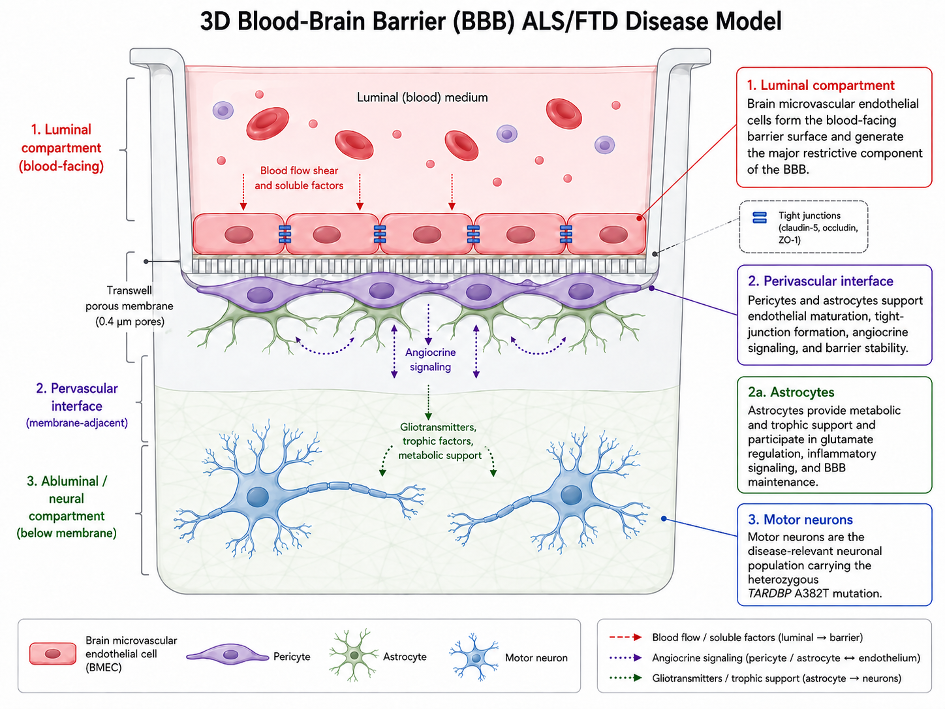
Traditional 2D cell cultures are valuable, but they often fail to reproduce the multicellular organization and signaling found within the human neurovascular unit. NeoBioPharma’s 3D BBB ALS/FTD Disease Model integrates:
- iPSC-derived motor neurons
-Primary Astrocytes
-Primary Pericytes
- Primary Brain microvascular endothelial cells
- A three-dimensional biomimetic scaffold
Together, these components create a more representative environment for studying how neurodegeneration and blood-brain barrier dysfunction may interact during ALS and FTD progression.
Study Disease Biology in a Relevant Genetic Background
The model incorporates a heterozygous TARDBP A382T mutation, a disease-associated genetic variant linked to ALS and FTD. Researchers can investigate disease-relevant endpoints including:
- TDP-43 cytoplasmic mislocalization
-TDP-43 aggregation
- Neuroinflammatory signaling
- Glutamate-associated excitotoxicity
- Neuronal degeneration
- Blood-brain barrier dysfunction
When paired with an isogenic gene-corrected control, the system can also help researchers distinguish mutation-associated effects from background genetic variability.
Evaluate Both Neuroprotection and BBB Penetration
One of the major challenges in neurological drug development is determining whether a therapeutic candidate can cross the blood-brain barrier while maintaining its biological activity.
The NeoBioPharma 3D BBB ALS/FTD Disease Model enables researchers to evaluate:
Barrier integrity through TEER and permeability measurements.
Drug transport across the endothelial barrier.
Neuronal responses after compound exposure.
Inflammatory signaling within the neurovascular environment.
Potential toxicity to endothelial, glial, and neuronal populations.
This provides a broader picture of therapeutic performance than neuronal assays alone.
Improve Translational Relevance
Animal models remain important in neurological research, but species-specific differences in BBB transporters, immune signaling, and neuronal biology can limit translation to humans. A fully human cell-based BBB disease model provides an additional experimental platform that can be used before advancing promising candidates into more complex preclinical studies.
Applications Across ALS and FTD Research
The NeoBioPharma model can support research in:
- Disease mechanism studies
- Biomarker discovery
-CNS drug permeability
-Neuroprotective compound screening
- Antisense oligonucleotide evaluation
- Gene therapy research
-Neuroinflammation studies
-TDP-43 biology
-Transporter and efflux studies
Build a More Complete Picture of ALS/FTD
ALS and FTD are multicellular diseases. Studying only one cell type can overlook important interactions between the nervous system and the cerebral vasculature.
The NeoBioPharma 3D Blood-Brain Barrier (BBB) ALS/FTD Disease Model brings key components of the human neurovascular unit together in one experimentally accessible platform, helping researchers investigate disease mechanisms, BBB function, and therapeutic response within a more biologically relevant environment. Advance your ALS and FTD research with a human-relevant 3D neurovascular disease model.
For Research Use Only. Not for diagnostic or therapeutic use.


Comments (0)
Leave a Comment