Why Your Cells Are Failing
The Hidden Sabotage in Your Lab: Why Your Cells Are Failing (And It’s Not Your Fault)
By Dr. James Whitfield
If you are a researcher, you know the sinking feeling. You open the incubator, grab your flask, and peer through the microscope. Instead of a beautiful, confluent monolayer of healthy, dividing cells, you see debris. You see rounded, floating bodies. You see cells that look stressed, grainy, and frankly, suicidal.
You check your calculations. You check the CO2 levels. You check for contamination. Everything is perfect. So why aren’t your cells growing?
The answer might be sitting right there on your lab bench, and it has nothing to do with your technique. It has everything to do with the brand war happening inside your flask.
You purchased your cryopreserved cells from Company A. You purchased your cell culture media and growth supplements from Company B because they were on sale, or because your lab has a standing contract with them.
On paper, this makes sense. Media is media, right? DMEM is DMEM, and FBS is FBS.
Wrong.
Here is the dirty little secret of the cell culture industry: Cells have memories, and they are fiercely loyal to their first "home."
The Adaptation Phenomenon
When a company like Company A creates a cell bank to bring to market, they don’t just throw the cells into generic media. They spend months—sometimes years—optimizing a specific "Master Mix." They tweak the amino acid concentrations, adjust the glucose levels, and use a specific lot of serum or a specific cocktail of recombinant proteins.
The cells don't just survive in this environment; they adapt to it. Over multiple passages, the cells' metabolism actually shifts to thrive in that specific chemical soup. Their ion channels, their receptor expression, and their stress-response pathways calibrate specifically to Company A’s proprietary formulation.
Then, Company A cryopreserved these cells. The cells are frozen in a state of suspended animation, carrying the "memory" of that specific media.
The "Frankenstein" Flask
Now, you come along. You order the cells from Company A, but you order your media from Company B.
You thaw the vial. You pipette the cells into your flask. You add the warm media from Company B.
To the cells, this feels like moving from a cozy, familiar home to a foreign country where they don't speak the language and the food is poisonous.
- Osmotic Shock: The salt balances might be slightly off.
- Starvation: Company B might use a different energy source or lack a specific trace element that Company A’s cells have become dependent on.
- Toxin Build-Up: Company B’s formulation might not neutralize metabolic waste products as efficiently as Company A’s custom brew.
The result? The cells enter a state of shock. They stop dividing. They round up. They die. You spend the next three weeks increasing the FBS concentration, adding extra glutamine, and praying to the science gods, but the cells never recover.
The Solution: Stop Mixing and Start Kitting
The industry has convinced you that you are a "mix-and-match" chef. You are not. You are a biologist trying to maintain a living organism.
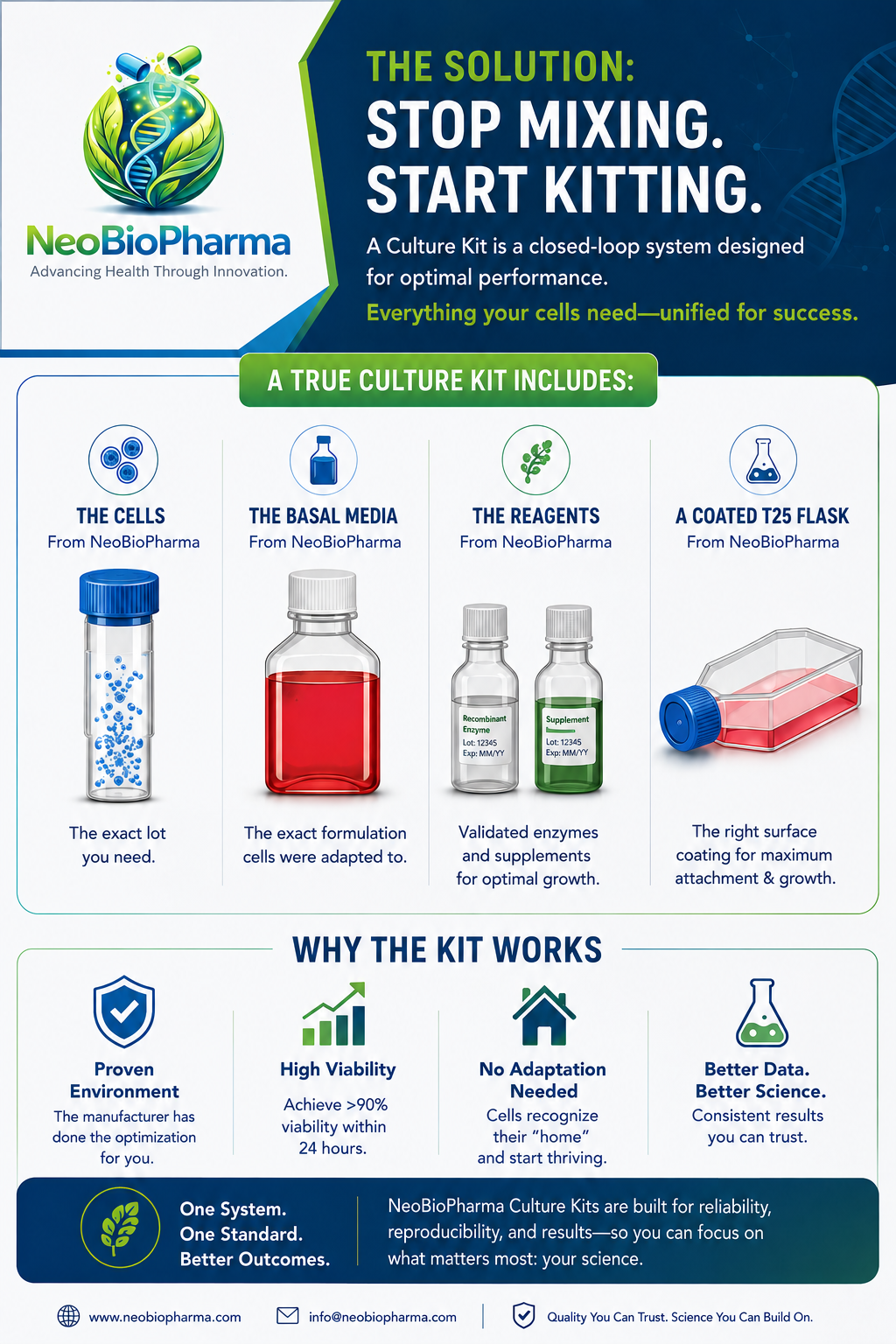
To guarantee success, you shouldn't be buying individual components from different vendors. You should be buying a "Culture Kit."
A proper Culture Kit is not just a marketing gimmick. It is a closed-loop biological system. Here is what a true Kit should include:
- The Cells (from Company A): The exact lot you need.
- The Basal Media (from Company A): The exact formulation the cells were adapted to during the expansion phase.
- The Reagents (from Company A): The specific dissociation enzymes (Trypsin/EDTA) and supplements that the manufacturer validated during their growth curves.
- A Coated T-25 Flask: This is critical. Company A knows exactly what surface coating (Collagen, Poly-L-Lysine, or proprietary matrix) yields the best attachment rate for their specific cells. Using your own generic flasks introduces yet another variable.
Why the Kit Works
When you purchase a Kit, you are essentially purchasing the manufacturer's "Quality Control" environment.
The manufacturer has already run the numbers. They know that if you thaw this vial, put it in this specific coated flask, and add this specific media, you will have a >90% viability within 24 hours. The cells don't have to adapt. They don't have to fight. They simply wake up, recognize the smell of "home," and start dividing.
The Bottom Line
Your cells are not failing because you are a bad scientist. They are failing because the multi-billion-dollar biotech industry has convinced you that all reagents are interchangeable.
They are not.
Cryopreservation is traumatic for cells. The last thing they need is a media swap on top of the thawing process. If you are experiencing chronic cell death, erratic doubling times, or spontaneous differentiation, stop chasing contamination ghosts.
Stop shopping for bargains across different catalogs. Start buying the Kit. Unify your supply chain.
When you use the media, reagents, and a flask that the cells were born in, you aren't just feeding them. You are giving them a familiar environment to thrive. And your data will finally reflect that.


Comments (0)
Leave a Comment