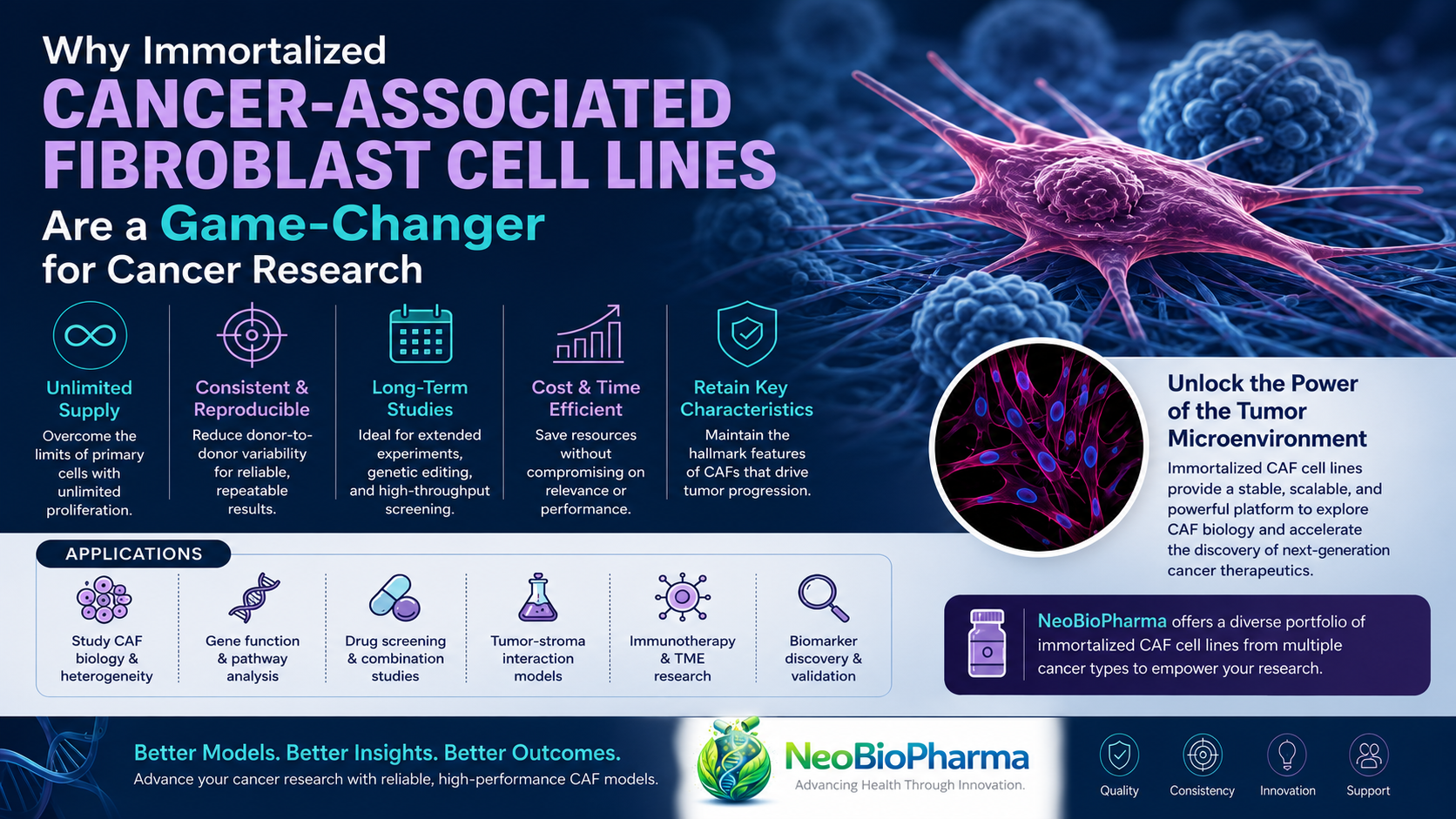
Why Immortalized Cancer-Associated Fibroblast Cell Lines Are a Game-Changer for Cancer Research
By Dr. James Whitfield
If you've spent any time working with Cancer-Associated Fibroblasts (CAFs), you already know the struggle. Primary CAFs are finicky, short-lived, and notoriously difficult to work with at scale. You isolate them, culture them, and just as they're getting interesting—they senescence.
Enter immortalized CAF cell lines.
For many researchers, the word "immortalized" can raise eyebrows. Are they truly representative? Do they behave like the real thing? The answer, when properly validated, is a resounding yes—and they come with a suite of advantages that can transform your research pipeline.
Here is why you should seriously consider making the switch to immortalized CAFs.
1. The "Endless Supply" Factor: Consistency and Reproducibility
One of the greatest challenges in cancer research is batch-to-batch variability. Primary CAFs are derived from individual patient tumors, and no two patients are alike. Their fibroblasts have different genetic backgrounds, different treatment histories, and different degrees of activation.
This means that every time you isolate a new batch of primary CAFs, you introduce a new variable.
Immortalized CAF lines solve this problem. They offer:
- An unlimited, renewable source of identical cells.
- Consistent behavior across passages, allowing you to run experiments months or years apart with the same genetic background.
- Reduced noise in your data, making it easier to detect true biological effects rather than patient-to-patient variation.
For high-throughput drug screening or long-term mechanistic studies, this reproducibility is non-negotiable.
2. Bypassing the Senescence Wall
Primary CAFs have a limited lifespan. After a certain number of population doublings (usually around 10–15), they enter replicative senescence. They stop dividing, change their secretory profile, and no longer behave like the active, tumor-promoting cells you set out to study.
This is a massive limitation. By the time you've optimized your assays and run your pilot experiments, your primary cells may already be on their last legs.
Immortalized CAFs, on the other hand, have been genetically modified to bypass senescence checkpoints (typically through hTERT overexpression or viral oncogenes like SV40 large T antigen). They can be cultured indefinitely, giving you:
- More time to design and execute complex experiments.
- More cells for large-scale omics studies, CRISPR screens, or co-culture systems.
- Peace of mind that your cells won't suddenly stop working mid-project.
3. Enabling CRISPR and Genetic Manipulation
If you're interested in dissecting the molecular mechanisms of CAF function, you need to manipulate gene expression. You might want to knock out a specific cytokine, overexpress a potential target, or introduce a reporter system.
Primary CAFs are notoriously difficult to transfect or transduce. They are slow-growing, sensitive to electroporation, and often mount stress responses to viral vectors.
Immortalized CAFs are far more amenable to genetic manipulation. They:
- Divide more readily, making them easier to transduce with lentivirus or retrovirus.
- Recover faster from transfection protocols.
- Yield stable knockout or overexpression lines that can be expanded and banked for future use.
This opens the door to sophisticated CRISPR-Cas9 knockout screens, pooled libraries, and lineage-tracing experiments that are simply impractical with primary cells.
4. Tissue-Specific Models: The NeoBioPharma Advantage
Not all CAFs are created equal. A lung CAF behaves very differently from a pancreatic CAF, which in turn is distinct from an ovarian CAF. The tissue of origin shapes their transcriptome, secretome, and interaction with immune cells.
This is why tissue-specific immortalized CAF lines are so valuable. With a comprehensive portfolio like NeoBioPharma's, which includes liver, lung, ovarian, pancreatic, prostate, colorectal, and kidney CAF models, you can:
- Study CAF biology in the correct anatomical context.
- Compare CAF behavior across different cancer types using the same experimental framework.
- Avoid the confounding effects of using a "generic" fibroblast line that doesn't reflect the disease you're studying.
The availability of both primary and immortalized counterparts for many of these tissues also allows for direct validation—you can confirm that key findings in the immortalized line hold true in the primary cells before moving to more complex models.
5. Cost and Time Efficiency
Let's talk about the practical side. Working with primary CAFs is expensive and time-consuming. It requires:
- Surgical or biopsy specimens.
- Ethical approvals and patient consent.
- Complex isolation and purification protocols.
- Ongoing culture maintenance with specialized media and growth factors.
Immortalized CAFs are off-the-shelf. You order them, thaw them, expand them, and get to work. No waiting for patient samples. No complicated isolations. No worrying about your primary culture becoming contaminated or going senescent mid-experiment.
This translates to:
- Faster project start times.
- Lower operating costs.
- More experiments per grant cycle.
6. Bridging the Gap to In Vivo Models
Finally, immortalized CAFs are excellent tools for preclinical in vivo studies. They can be co-injected with cancer cells to study tumor engraftment, metastasis, and response to therapy. Because they are stable and well-characterized, they provide a consistent "stromal background" that allows you to isolate the effects of genetic manipulations in the CAF population.
Some researchers worry that immortalized CAFs might lose their tumor-promoting properties. However, well-validated lines retain key features, including:
- Expression of CAF markers (FAP, -SMA, PDGFR).
- Secretion of tumor-promoting cytokines (IL-6, CXCL12, TGF-).
- ECM remodeling capabilities.
- Immunosuppressive functions.
Addressing the Elephant in the Room: "Are They Real?"
The most common objection to immortalized CAFs is that they are "not physiological." It's a fair concern. Genetic modifications can alter cell behavior, and prolonged culture can lead to drift.
The key is validation. Reputable suppliers like NeoBioPharma rigorously validate their immortalized lines against primary counterparts, confirming that they maintain:
- Morphology and growth characteristics.
- Marker expression profiles.
- Functional responses (e.g., cytokine secretion, matrix remodeling).
- Genomic stability (to a reasonable degree).
When you choose well-characterized, tissue-specific immortalized CAFs, you are not sacrificing biology for convenience. You are choosing a standardized, scalable, and reproducible system that complements—rather than replaces—primary cell work.
The Bottom Line
Cancer-Associated Fibroblasts are no longer the "neglected" cells of the tumor microenvironment. They are central players in tumor progression, metastasis, and therapy resistance. To study them effectively, you need tools that keep up with your ambition.
Immortalized CAF cell lines offer:
 Unlimited supply Consistent performance Amenability to genetic manipulation Cost and time efficiency Tissue-specific relevance
Don't let the limitations of primary cells hold back your research. With a robust portfolio of immortalized CAF models—spanning liver, lung, ovarian, pancreatic, prostate, colorectal, and kidney cancers—NeoBioPharma is providing researchers with the tools they need to ask bigger questions and get clearer answers.
Your CAF research deserves a model that works as hard as you do. Make the switch to immortalized lines and unlock the full potential of your cancer research.


Comments (0)
Leave a Comment