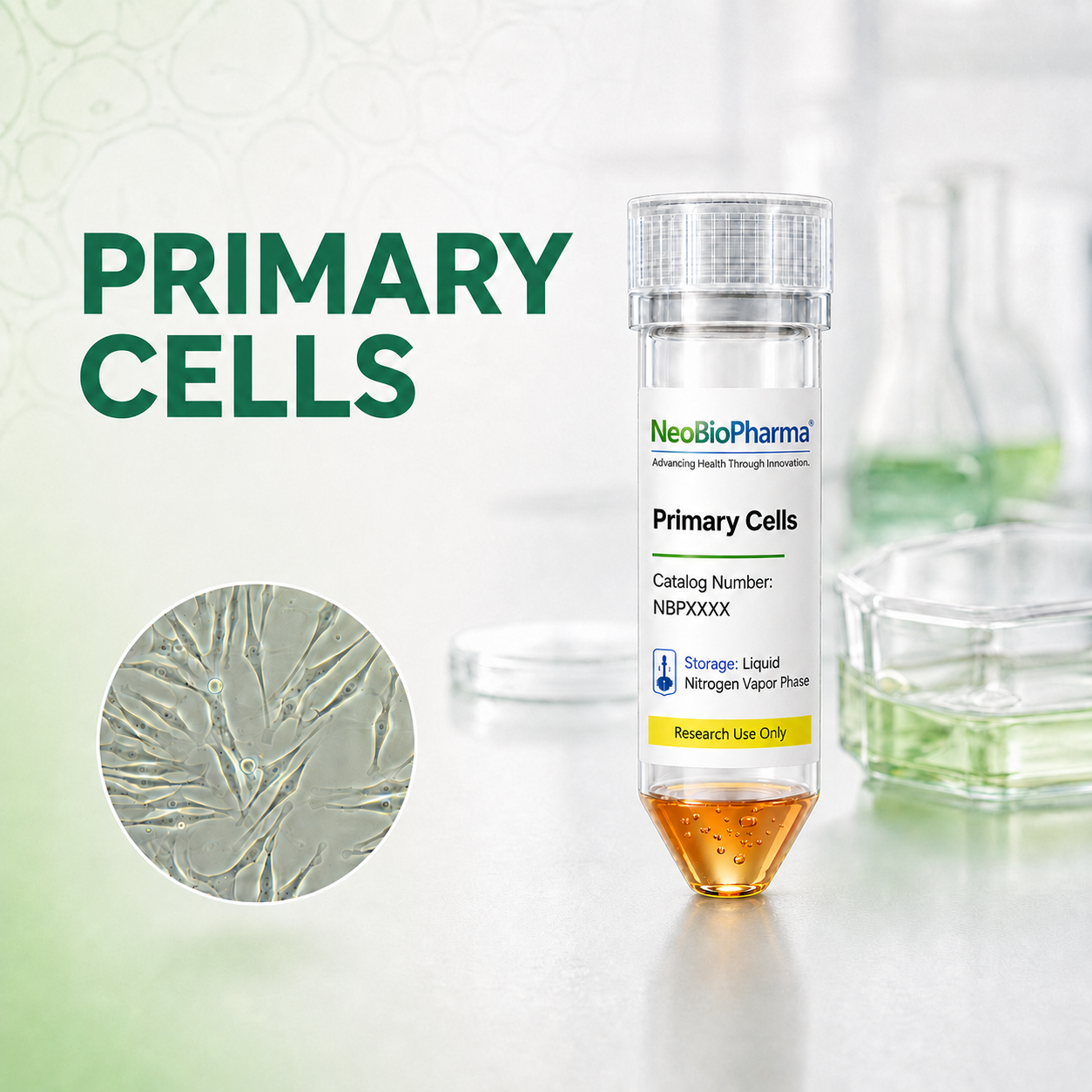
Human Diabetic Primary Coronary Artery Fibroblast Cells

Quick Actions
Product Overview
Description
Human Diabetic Primary Coronary Artery Fibroblast Cells are cryopreserved primary human fibroblast cells intended for in vitro research on diabetes-associated cellular dysfunction. The product is supplied as an early-passage culture and is designed for mechanistic studies, disease modeling, assay development, and pharmacology. The scientific profile emphasizes preservation of tissue-relevant phenotype while minimizing passage-related drift.
Guarantee expansion for a minimum of 2-5 population
doublings.
IMPORTANT: Quality warranty requires use of NeoBioPharma media. Biohazardous material despite negative pathogen testing. Quality claims must be reported within 1 month.
Key Features
Catalog Number: NBPDF004
Product Format: Frozen
Vial Cell Number: > 5x10[5] cells/vial
Passage:1(P1)
Storage: Liquid Nitrogen, Vapor Phase
Intended Use: Research use only (RUO)
Characterization Markers
- Characterized by spindle morphology under light microscopy.
- Negative for von Willebrand Factor (vWF) , Cytokeratin 18,
and alpha-smooth muscle actin .
- Isolated and characterized to ensure fibroblast purity and identity.
Quick Facts
Product Type
Human Type II Diabetes Endothelial Cells
Viability
>95% viable (Trypan Blue exclusion)
Applications
-Drug Discovery & Toxicity: Testing novel anti-fi…
Availability
In Stock • Global Shipping
Technical Specifications
Primary Applications
Applications & Use Cases
Primary Applications
-Drug Discovery & Toxicity: Testing novel anti-fibrotic agents (e.g.
Suitable for -drug discovery & toxicity: testing novel anti-fibrotic agents (e.g. studies and research applications
pirfenidone analogs
Suitable for pirfenidone analogs studies and research applications
galectin-3 inhibitors) or SGLT2 inhibitors (which have shown direct anti-fibrotic effects in the heart) on cells that already possess a pro-fibrotic baseline. -Mechanistic Studies: Investigating signaling pathways activated by diabetes
Suitable for galectin-3 inhibitors) or sglt2 inhibitors (which have shown direct anti-fibrotic effects in the heart) on cells that already possess a pro-fibrotic baseline. -mechanistic studies: investigating signaling pathways activated by diabetes studies and research applications
such as the RAGE (Receptor for AGEs) axis
Suitable for such as the rage (receptor for ages) axis studies and research applications
TGF-\beta (Transforming Growth Factor-beta) /Smad signaling
Suitable for tgf-\beta (transforming growth factor-beta) /smad signaling studies and research applications
and PKC (Protein Kinase C) isoforms. -Co-Culture Models: Studying paracrine signaling by co-culturing these fibroblasts with coronary artery endothelial cells or smooth muscle cells to understand how diabetes disrupts endothelial-fibroblast communication. -Metabolism: Studying how altered glucose and fatty acid metabolism in diabetic fibroblasts contributes to the Warburg effect (aerobic glycolysis) in vascular remodeling.
Suitable for and pkc (protein kinase c) isoforms. -co-culture models: studying paracrine signaling by co-culturing these fibroblasts with coronary artery endothelial cells or smooth muscle cells to understand how diabetes disrupts endothelial-fibroblast communication. -metabolism: studying how altered glucose and fatty acid metabolism in diabetic fibroblasts contributes to the warburg effect (aerobic glycolysis) in vascular remodeling. studies and research applications
Research Areas
In Vitro Studies
Cell culture and screening applications
Molecular Biology
Gene expression & signaling studies
Drug Discovery
Screening & validation studies
Disease Modeling
Pathophysiology research
Support & Resources
Technical Support
Our experts are available for technical questions and protocol assistance.
Contact Support