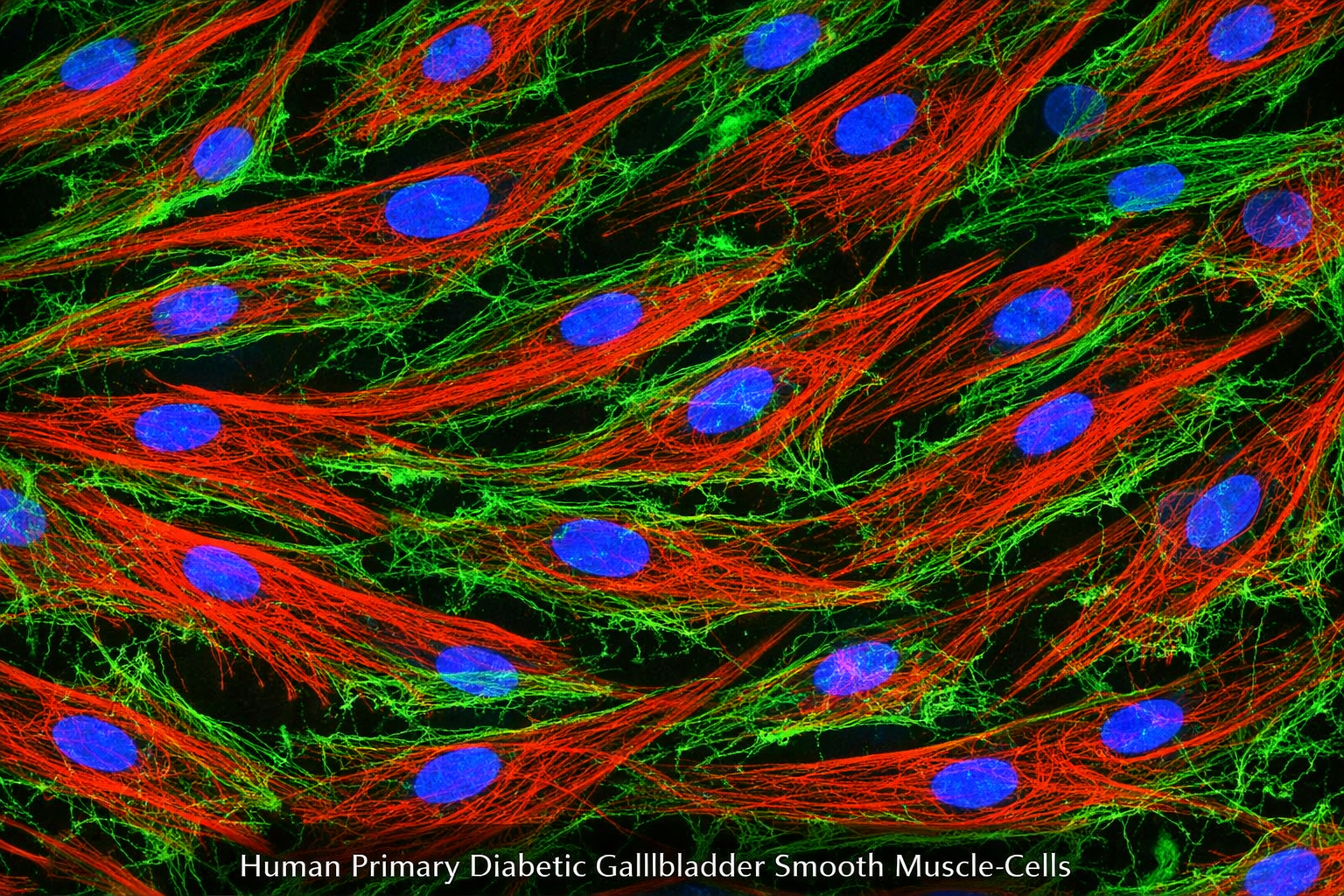
Human Primary Diabetic Artery Smooth Muscle Cells

Quick Actions
Product Overview
Description
Human Primary Diabetic Artery Smooth Muscle Cells are cryopreserved primary smooth-muscle cells for in vitro research. The product supports tissue-relevant mechanistic studies, disease modeling, assay development, pharmacology, and cell-biology applications. Early-passage use and standardized culture conditions are recommended to minimize phenotype drift.
Guarantee expansion for a minimum of 2-6 population
doublings.
IMPORTANT: Quality warranty requires use of NeoBioPharma media. Biohazardous material despite negative pathogen testing. Quality claims must be reported within 1 month.
Key Features
Catalog Number: NBPDS002
Product Format: Frozen
Vial Cell Number: > 5x10[5] cells/vial
Passage:1(P1)
Storage: Liquid Nitrogen, Vapor Phase
Intended Use: Research use only (RUO)
Characterization Markers
Characterized by positive expression of smooth muscle cell-specific alpha-actin .
Quick Facts
Product Type
Human Type II Diabetes Endothelial Cells
Viability
>95% viable (Trypan Blue exclusion)
Applications
-Proliferation and Migration: Diabetic VSMCs ofte…
Availability
In Stock • Global Shipping
Technical Specifications
Primary Applications
Applications & Use Cases
Primary Applications
-Proliferation and Migration: Diabetic VSMCs often exhibit increased proliferation and migration in response to high glucose or insulin
Suitable for -proliferation and migration: diabetic vsmcs often exhibit increased proliferation and migration in response to high glucose or insulin studies and research applications
contributing to neointimal hyperplasia. -Advanced Glycation End-products (AGEs): Studying how AGEs (which accumulate in diabetes) interact with their receptor (RAGE) on VSMCs to cause inflammation. -Oxidative Stress: Measuring reactive oxygen species (ROS). VSMCs from diabetic donors usually have impaired antioxidant defenses. -Contractility: Examining the switch from a "contractile" (healthy
Suitable for contributing to neointimal hyperplasia. -advanced glycation end-products (ages): studying how ages (which accumulate in diabetes) interact with their receptor (rage) on vsmcs to cause inflammation. -oxidative stress: measuring reactive oxygen species (ros). vsmcs from diabetic donors usually have impaired antioxidant defenses. -contractility: examining the switch from a "contractile" (healthy studies and research applications
quiescent) phenotype to a "synthetic" (pathological
Suitable for quiescent) phenotype to a "synthetic" (pathological studies and research applications
proliferative) phenotype. -Epigenetics: Investigating how high glucose has permanently altered gene expression (e.g.
Suitable for proliferative) phenotype. -epigenetics: investigating how high glucose has permanently altered gene expression (e.g. studies and research applications
via histone modifications) even when cells are removed from the body.
Suitable for via histone modifications) even when cells are removed from the body. studies and research applications
Research Areas
In Vitro Studies
Cell culture and screening applications
Molecular Biology
Gene expression & signaling studies
Drug Discovery
Screening & validation studies
Disease Modeling
Pathophysiology research
Support & Resources
Technical Support
Our experts are available for technical questions and protocol assistance.
Contact Support