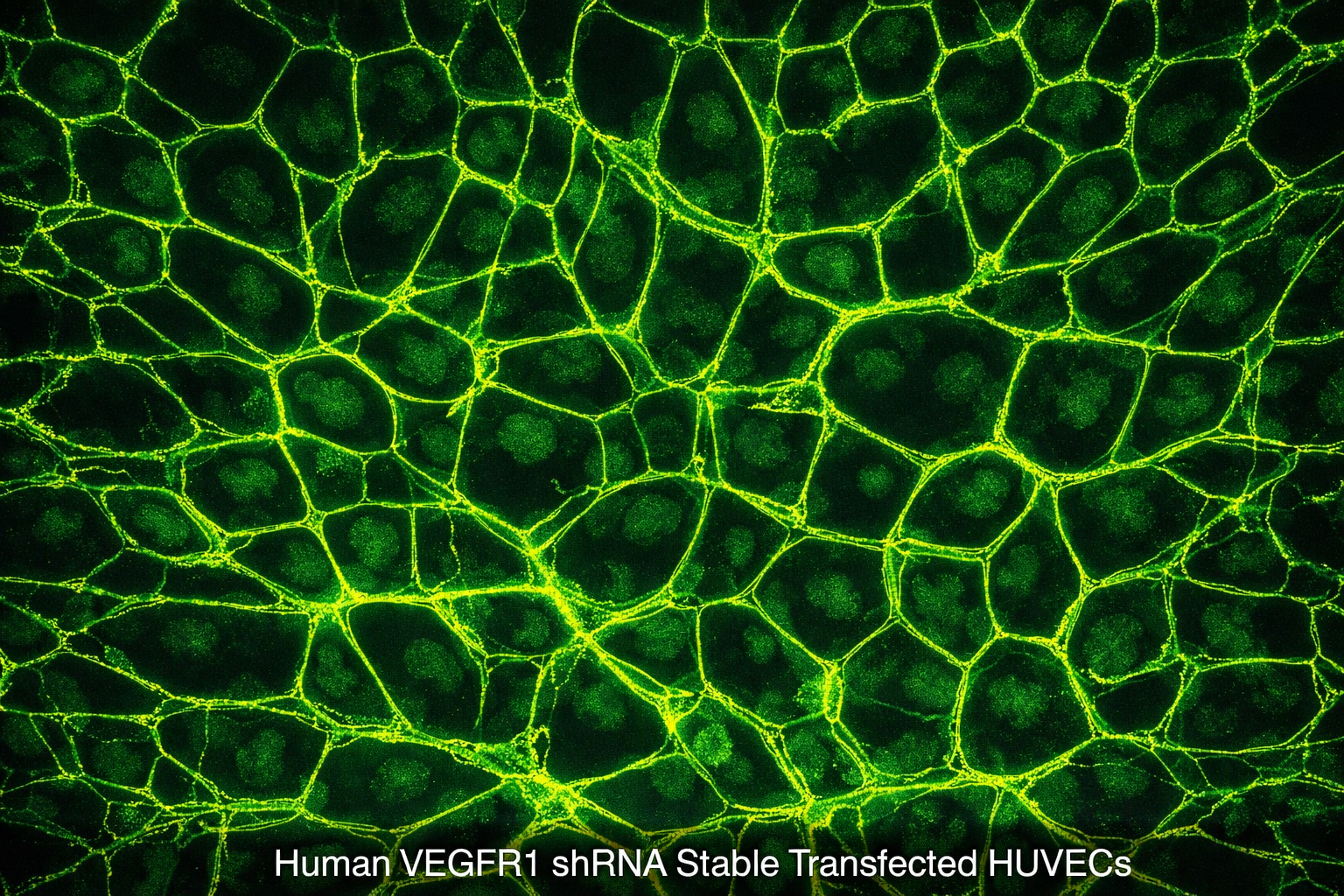
Human VEGFR2 shRNA Stable Transfected HUVECs

Quick Actions
Documentation 0 files
Product Overview
Description
VEGFR2 serves as the primary receptor responsible for mediating the signaling pathways associated with VEGF-driven angiogenesis. This vital receptor plays a crucial role in regulating several key processes in endothelial cells, including their proliferation, migration, and survival.
By employing stable shRNA knockdown in human umbilical vein endothelial cells (HUVECs), researchers can conduct long-term functional studies on the effects of VEGFR2 inhibition. This approach minimizes the impact of transient variability, allowing for more accurate and consistent results in understanding the role of VEGFR2 in angiogenic processes.
Guarantee expansion for a minimum of 2-5 population
doublings.
IMPORTANT: Quality warranty requires use of NeoBioPharma media. Biohazardous material despite negative pathogen testing. Quality claims must be reported within 1 month.
Key Features
Catalog Number: NBP-0001-siRNAVEGFR2
Product Format: Frozen
Vial Cell Number: > 5x10[5] cells/vial
Passage:1(P1)
Storage: Liquid Nitrogen, Vapor Phase
Intended Use: Research use only (RUO)
CELL CHARACTERISTICS
-Cell type: Human Umbilical Vein Endothelial Cells (HUVECs)
-Genetic modification: Stable integration of VEGFR2-targeting shRNA
-Target gene: VEGFR2 (KDR / Flk-1)
-Functional effect: Reduced VEGFR2 expression and downstream VEGF signaling
-Phenotype:
-Decreased VEGF-induced proliferation
-Reduced migration and tube formation capacity
-Altered angiogenic response
-Stability: Long-term gene silencing maintained through multiple passages
-Common markers retained: CD31, vWF, VE-cadherin (depending on selection system)
Quick Facts
Product Type
Human Endothelial cells
Viability
>95% viable (Trypan Blue exclusion)
Applications
-Angiogenesis research (VEGF–VEGFR2 pathway studi…
Availability
In Stock • Global Shipping
Technical Specifications
Primary Applications
Applications & Use Cases
Primary Applications
-Angiogenesis research (VEGF–VEGFR2 pathway studies) -Cancer biology (tumor-induced vessel formation models) -Drug screening for anti-angiogenic compounds (e.g.
Suitable for -angiogenesis research (vegf–vegfr2 pathway studies) -cancer biology (tumor-induced vessel formation models) -drug screening for anti-angiogenic compounds (e.g. studies and research applications
tyrosine kinase inhibitors) -Endothelial signaling studies -Vascular disease modeling (ischemia
Suitable for tyrosine kinase inhibitors) -endothelial signaling studies -vascular disease modeling (ischemia studies and research applications
atherosclerosis mechanisms) -Mechanistic studies of VEGF inhibition
Suitable for atherosclerosis mechanisms) -mechanistic studies of vegf inhibition studies and research applications
Research Areas
In Vitro Studies
Cell culture and screening applications
Molecular Biology
Gene expression & signaling studies
Drug Discovery
Screening & validation studies
Disease Modeling
Pathophysiology research
Support & Resources
Technical Support
Our experts are available for technical questions and protocol assistance.
Contact SupportDocumentation & Resources
No Documentation Available
Documentation for this product is not yet available.
Request Documentation