
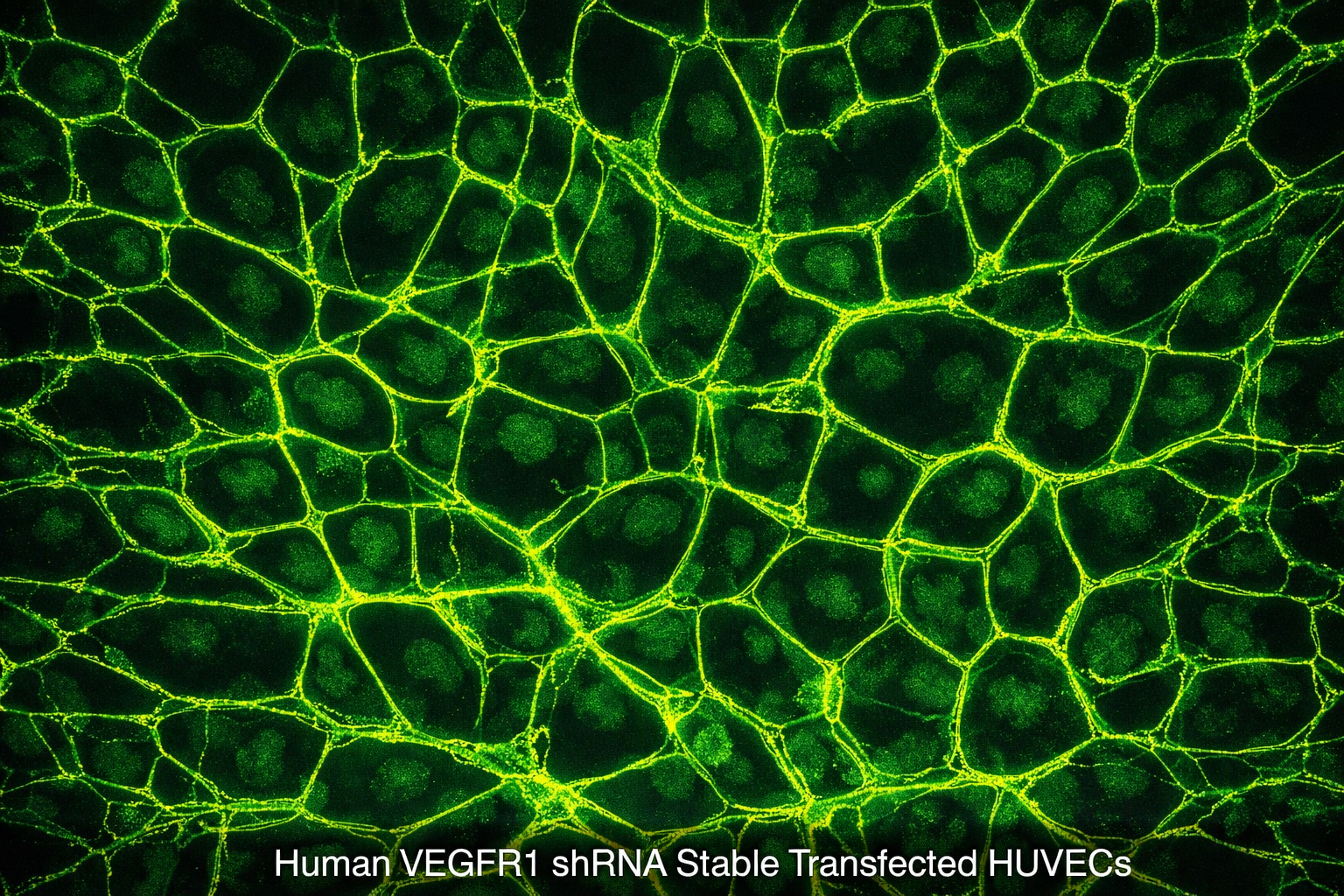
Human VEGFR1 shRNA Stable Transfected HUVECs
Quick Actions
Product Overview
Description
Human VEGFR1 shRNA Stable Transfected Human Umbilical Vein Endothelial Cells (HUVECs) are genetically modified endothelial cells engineered to stably express short hairpin RNA (shRNA) targeting the Vascular Endothelial Growth Factor Receptor 1 (VEGFR1/Flt-1) gene. This stable knockdown reduces VEGFR1 expression, allowing researchers to investigate its role in endothelial cell signaling, angiogenesis, vascular development, and disease progression.
These cells maintain the fundamental characteristics of primary HUVECs while providing a reliable in vitro model for long-term functional studies involving VEGFR1 suppression.
IMPORTANT: Quality warranty requires use of NeoBioPharma media. Biohazardous material despite negative pathogen testing. Quality claims must be reported within 1 month.
Key Features
Catalog Number: NBP-0001siRNAVEGFR1
Product Format: Frozen
Vial Cell Number: > 5x10[5] cells/vial
Passage:1(P1)
Storage: Liquid Nitrogen, Vapor Phase
Intended Use: Research use only (RUO)
CELL CHARACTERISTICS
-Stable shRNA-mediated knockdown of VEGFR1 (Flt-1) expression.
-Human endothelial cell morphology with typical cobblestone appearance.
-Reduced VEGFR1 mRNA and protein levels.
-Altered VEGF signaling pathways and receptor interactions.
-Suitable for long-term experiments without repeated transfection.
-Retains expression of endothelial markers such as:
-CD31 (PECAM-1)
-VE-Cadherin (CD144)
-von Willebrand Factor (vWF)
-Compatible with fluorescence imaging, molecular biology, and functional assays.
-High reproducibility for angiogenesis and vascular biology research.
Quick Facts
Product Type
Human Endothelial cells
Viability
>95% viable (Trypan Blue exclusion)
Applications
-Angiogenesis Research Investigation of VEGFR1 f…
Availability
In Stock • Global Shipping
Technical Specifications
Primary Applications
Applications & Use Cases
Primary Applications
-Angiogenesis Research Investigation of VEGFR1 function in blood vessel formation. Analysis of endothelial migration
Suitable for -angiogenesis research investigation of vegfr1 function in blood vessel formation. analysis of endothelial migration studies and research applications
proliferation
Suitable for proliferation studies and research applications
and tube formation. Evaluation of VEGF-mediated signaling mechanisms. -Cancer and Tumor Biology Study of tumor-associated angiogenesis. Assessment of VEGFR1 involvement in tumor vascularization. Screening of anti-angiogenic therapeutics. -Vascular Disease Studies Research on atherosclerosis and vascular remodeling. Investigation of endothelial dysfunction. Analysis of inflammatory vascular responses. -Drug Discovery and Development Validation of VEGFR1-targeted therapies. Screening of small molecules
Suitable for and tube formation. evaluation of vegf-mediated signaling mechanisms. -cancer and tumor biology study of tumor-associated angiogenesis. assessment of vegfr1 involvement in tumor vascularization. screening of anti-angiogenic therapeutics. -vascular disease studies research on atherosclerosis and vascular remodeling. investigation of endothelial dysfunction. analysis of inflammatory vascular responses. -drug discovery and development validation of vegfr1-targeted therapies. screening of small molecules studies and research applications
antibodies
Suitable for antibodies studies and research applications
and biologics. Evaluation of pathway-specific therapeutic interventions. -Molecular Signaling Studies Investigation of VEGF/VEGFR signaling networks. Examination of receptor cross-talk between VEGFR1 and VEGFR2. Analysis of downstream signaling pathways including PI3K/Akt and MAPK.
Suitable for and biologics. evaluation of pathway-specific therapeutic interventions. -molecular signaling studies investigation of vegf/vegfr signaling networks. examination of receptor cross-talk between vegfr1 and vegfr2. analysis of downstream signaling pathways including pi3k/akt and mapk. studies and research applications
Research Areas
In Vitro Studies
Cell culture and screening applications
Molecular Biology
Gene expression & signaling studies
Drug Discovery
Screening & validation studies
Disease Modeling
Pathophysiology research
Support & Resources
Technical Support
Our experts are available for technical questions and protocol assistance.
Contact Support